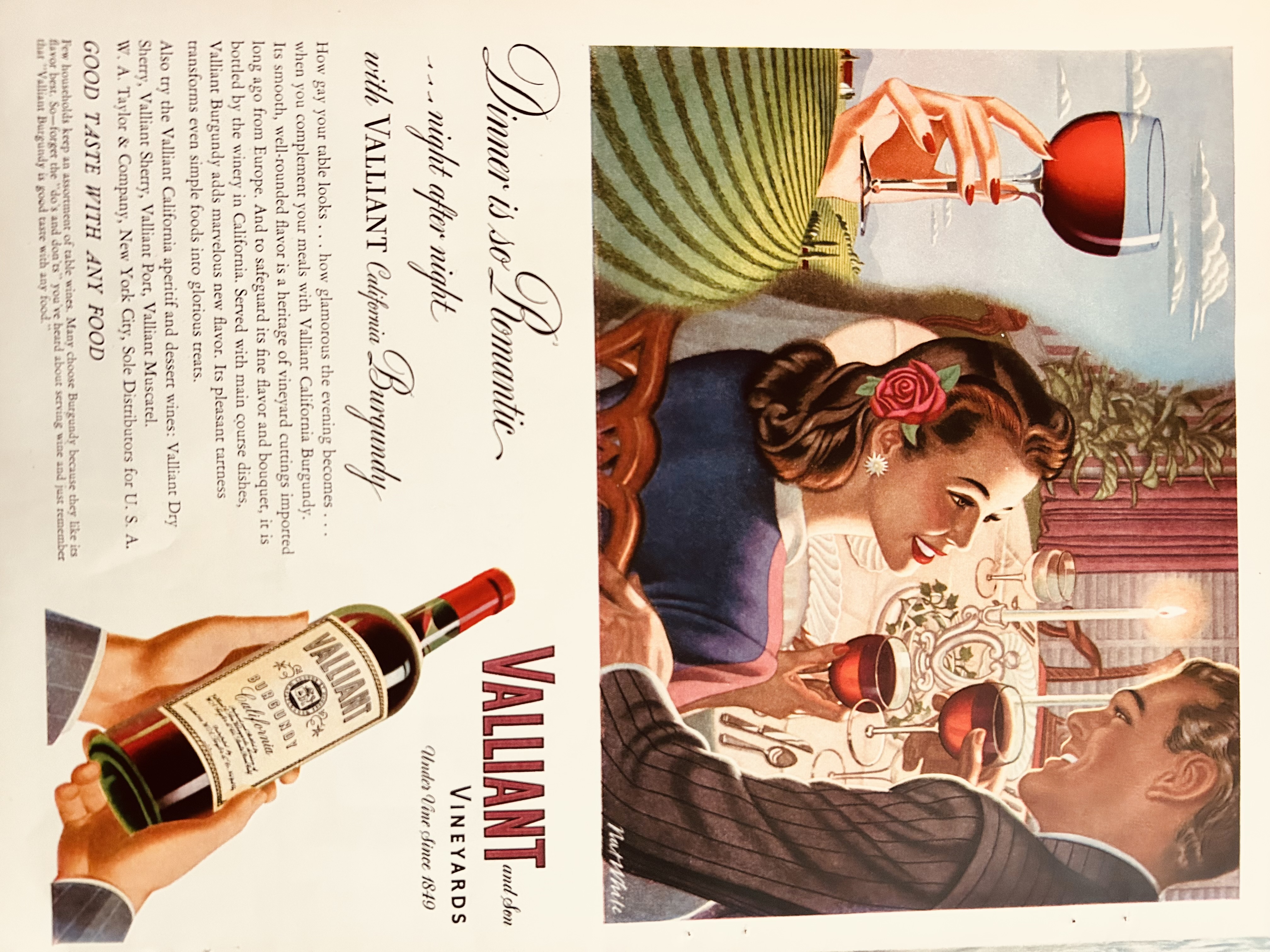
This advertisement for Valliant & Sons Vineyards, published circa the mid-1940s, invites readers to a candlelit dinner during which a glass of California Burgundy transforms an ordinary evening into a glamour-drenched affair worthy of a rose pinned in your hair.
Snark aside, at first glance this is simply a charming piece of postwar advertising. But it also raises a fascinating question about the evolution of American wine culture: What became of Valliant & Son?
After all, the winery proudly proclaimed "Under Vine Since 1849." By the time this advertisement appeared, the vineyard had already boasted nearly a century of history. It's only natural to wonder what became of such an established California label.
The answer speaks to the remarkable continuity of American winegrowing.
Today, the historic property once known as Valliant is Eden Rift, which proudly describes itself as the oldest continually producing vineyard in California. The vineyard has remained under vine since 1849, spanning nearly two centuries of uninterrupted cultivation. Europe still enjoys a considerable head start, but here in the US, we finally have a few centuries of wine history under our belt.
The Valliant years represent an important chapter in the story of this remarkable vineyard, nestled in the Cienega Valley of San Benito County, southeast of Hollister along California's Central Coast. Around the repeal of Prohibition, Edwin Valliant and his son purchased the property, renaming it Valliant & Son Vineyards. In 1943, they sold the estate to W. A. Taylor, a subsidiary of Hiram Walker & Sons, the renowned Canadian distilling company. Under Taylor's ownership, the winery was modernized, but the Valliant name remained on the label, continuing to introduce American consumers to California every day wines.
It is perhaps the advertisement's smallest paragraph that proves its most revealing:
Forget the 'do's and don'ts' you've heard about serving wine and just remember that Valliant Burgundy is good taste with any food.
It is a remarkably modern sentiment.
Even eighty years ago, wineries understood that many Americans found wine intimidating. Questions about food pairings, serving temperatures, glassware, and etiquette often discouraged people from bringing an unfamiliar bottle to the dinner table. Rather than reinforcing those anxieties, Valliant sought to erase them. Its message was simple: wine belongs not to experts, but to everyone.
One detail immediately catches the modern reader's eye: the featured bottle is labeled California Burgundy.
Today, that designation has disappeared from American wine labels, replaced by grape varieties such as Pinot Noir and Chardonnay. But in the first half of the twentieth century, wineries throughout California routinely borrowed the names of famous European wine regions (e.g. Burgundy, Chablis, Sauternes, and Rhine) not to suggest geographic origin, but to communicate a familiar style of wine to American consumers.
At the time, few wine drinkers knew the names Pinot Noir, Cabernet Sauvignon, or Chardonnay. Regional names were far more recognizable, serving as a kind of shorthand for wines that resembled those produced in Europe.
If this advertisement were created today, the bottle labeled California Burgundy would most likely be presented as a Pinot Noir, the grape that has long defined the great red wines of Burgundy, France. In that sense, the modern Eden Rift Pinot Noir offers a compelling bridge between the past and the present: the same historic vineyard, the same family legacy, but expressed through the language of today's wine world.
Our Modern Pour
Indeed, the Valliant family name lives on today at Eden Rift Vineyards, where both the Central Coast Chardonnay and Central Coast Pinot Noir are named in their honor. It's a fitting tribute to the family who stewarded one of California's oldest continuously cultivated vineyard sites during the 1930s and 1940s.
Situated on the Gavilan Mountain Range approximately twenty miles inland from Monterey Bay, the historic Eden Rift vineyard has remained under vine since 1849. Today, cooling Pacific influences, elevated coastal terrain, and meticulous estate farming continue to define wines that express the character of this remarkable site.
The Eden Rift Central Coast Chardonnay is produced exclusively from estate-grown fruit. Whole-cluster pressed, fermented with native yeasts, and aged sur lie for eleven months in neutral French oak barrels, it showcases the vineyard itself rather than the influence of new oak.
Its companion, the Eden Rift Central Coast Pinot Noir, is likewise crafted entirely from estate-grown grapes, fermented with native yeasts, and aged for eleven months in neutral French oak. Elegant and site-driven, it reflects the same commitment to authenticity that has defined this historic property for generations.