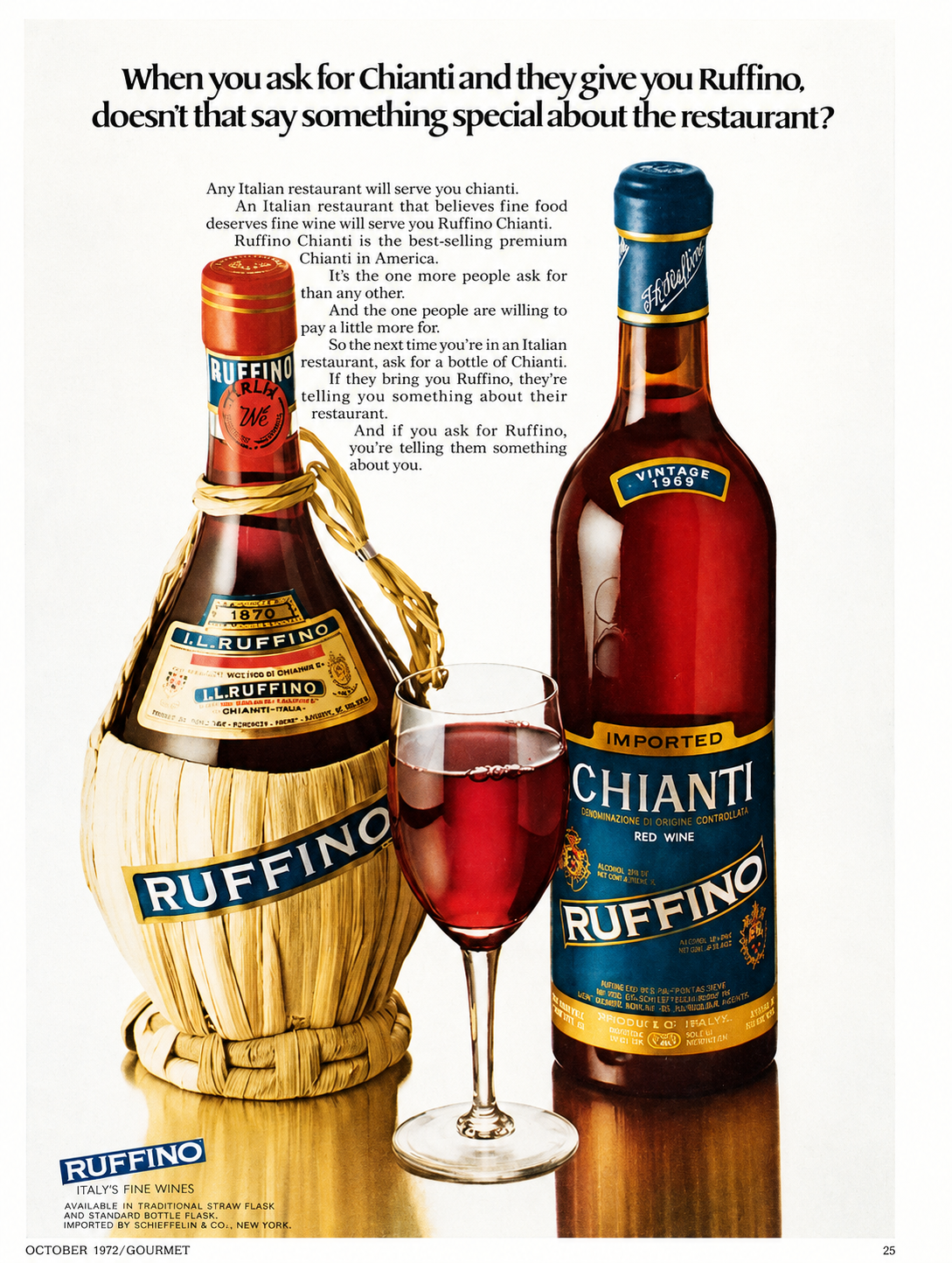
This October 1972 advertisement from Gourmet magazine is about far more than a bottle of Chianti. I believe it captures a remarkable moment in the evolution of Italian wine in America and the changing way Americans, including many Italian Americans, understood their culinary heritage.
The advertisement features two bottles containing the very same wine. One is the familiar fiasco, the straw-covered flask that had been used in Tuscany for centuries. Beside it stands a sleek, modern glass bottle. The juxtaposition is striking, and almost certainly intentional.
Originally, the woven straw surrounding the fiasco served a practical purpose. It protected fragile, hand-blown glass, allowing the rounded bottle to stand upright during transport and storage. Over time, however, the bottle became something more than a package. In the United States, the fiasco evolved into one of the most recognizable symbols of Italian American culture. It appeared on restaurant tables across the country and often found a second life as a candleholder long after the wine had been enjoyed. For many Americans, the straw-covered bottle did not simply contain Chianti: it was Chianti.
By the mid-twentieth century, the fiasco had become part of a broader visual language associated with Italian America, alongside spaghetti dinners, red-checkered tablecloths, and crooners like Dean Martin. It was an affectionate image, but also one that simplified the extraordinary diversity of Italian wine culture into a single familiar stereotype.
Ruffino's advertisement offers a different perspective.
Rather than replacing the fiasco, the company presents it alongside a contemporary glass bottle. The two bottles contain the same wine, yet each speaks a different visual language. One evokes Tuscany's long winemaking tradition and mid-twentieth century Italian-Americana. The other reflects the increasingly sophisticated world of American fine dining culture. Together, they suggest that Chianti should no longer be understood solely through the imagery that had introduced it to America. It could honor its heritage while presenting itself with the confidence expected of the world's greatest European wines. The choice of Gourmet magazine for this ad placement renders the message especially meaningful: Unlike mass-market publications, Gourmet catered to readers who viewed food as culture rather than convenience. Its educated audience poured over cookbooks, explored regional cuisines, entertained at home, and increasingly approached wine with curiosity and discernment. Ruffino wasn't trying to persuade Americans to drink Chianti; they were already doing that. Instead, it invited them to think differently about it.
Consumers were not asked to choose between the old bottle and the new one. Instead, it suggests that both belong to the same story. The fiasco remains a proud symbol of Chianti's past, while the modern bottle points toward its future. Together, they illustrate how Italian wine could embrace modern tastes without abandoning the traditions that made it distinctive.
Today, Chianti is more often discussed in terms of appellations, producers, vineyards, and terroir than by the shape of its bottle. Yet the fiasco remains one of the most enduring symbols in the history of Italian wine. This is not because it represents a lesser era, but because it introduced generations of Americans to Italian wine and culture.