Long before Napa Cabernet became a household name and decades before California earned international acclaim at the 1976 Judgment of Paris (See: Chateau Montelena), wineries often relied on romantic imagery and Old World storytelling to introduce Americans to wine.
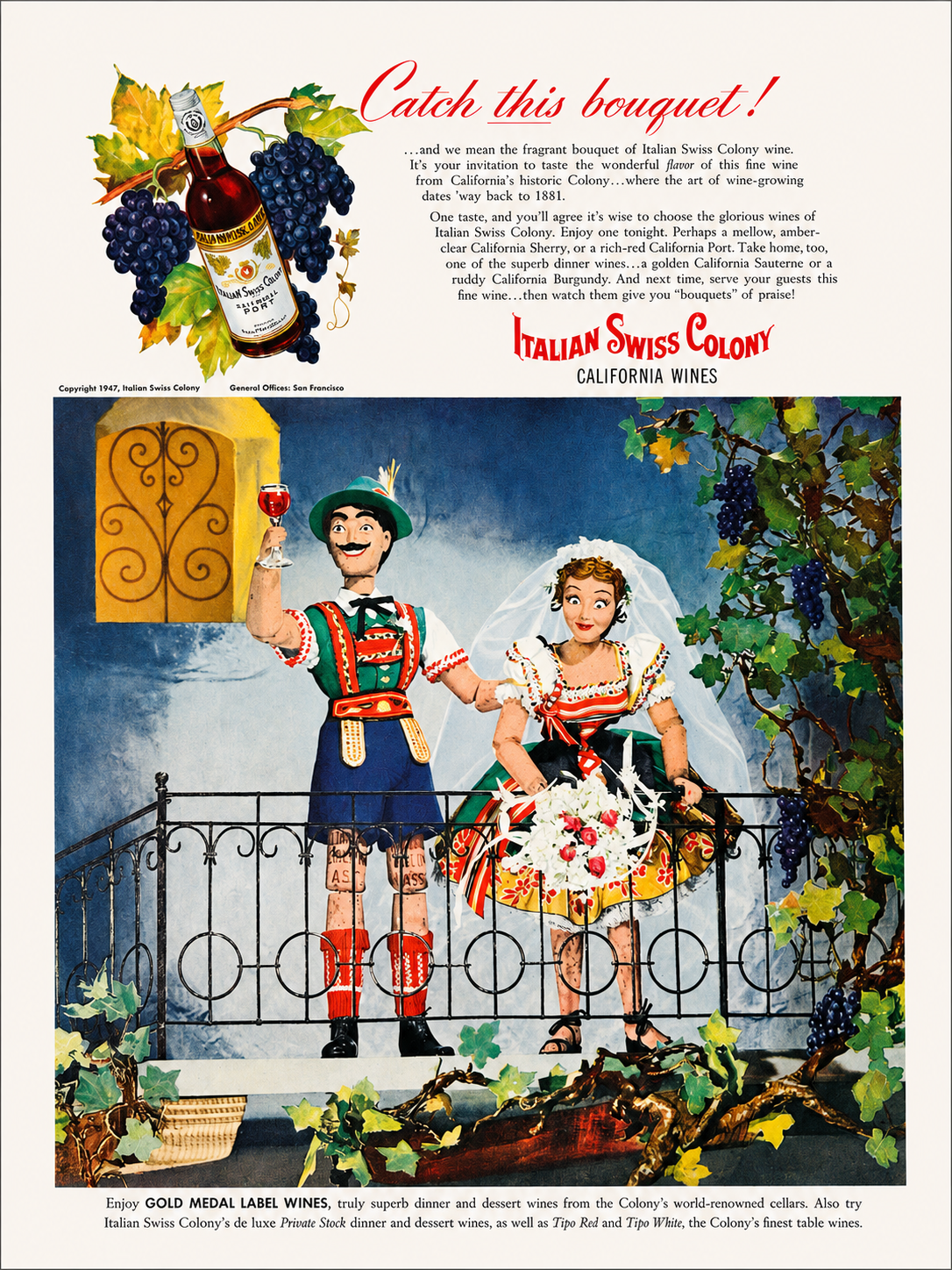
This 1947 advertisement from Italian Swiss Colony is a perfect example.
Founded in 1881 by Northern Italian immigrant Andrea Sbarboro, a native of Genoa, Italian Swiss Colony began as an agricultural cooperative in Sonoma County's Asti region. Created to provide opportunities for Italian and Swiss immigrants in California, the Colony's name reflected the close cultural and economic ties between Northern Italy and neighboring Switzerland, as well as the diverse mix of Italian and Swiss-Italian settlers who helped shape California's early wine industry. What began as a vineyard settlement grew into one of the largest and most influential wine companies in the United States. By the early twentieth century, its wines had earned international acclaim, and the winery itself had become one of California's most celebrated tourist destinations.
The ad's headline, Catch This Bouquet!, is an early attempt at wine education: It plays on the dual meaning of a wedding bouquet and a wine's aroma. Indeed, in 1947, America was entering a period of postwar prosperity, and California wineries were working to rekindle the nation's interest in wine after the twin disruptions of Prohibition and World War II. Finally, there would be time and mental space for wine knowledge to capture the American imagination. By emphasizing tradition, flavor, and refinement rather than alcohol itself, Italian Swiss Colony sought to position wine as a sophisticated yet approachable part of everyday American life.
The artwork is equally revealing: A smiling bride and groom dressed in romanticized Alpine-European costumes stand on a balcony surrounded by grapevines. The imagery blends Italian and Swiss cultural references into a cheerful vision of Old World heritage transplanted to California. It is less a depiction of reality than a celebration of immigrant identity at a time when many Americans still viewed wine as a European tradition. The scene also reflected the optimistic spirit of postwar America, presenting immigrant heritage not as something foreign, but as an integral part of the American Dream that millions of families were pursuing in the years following World War II.
Perhaps most striking is the range of wines being promoted. Alongside table wines, Italian Swiss Colony highlights California Port and California Sauterne. Far less popular today, these styles were enormously popular in postwar America. In the 1940s, consumers often thought of wine in broad stylistic categories rather than by grape variety. Cabernet Sauvignon and Chardonnay were not yet common parlance.
The advertisement also reminds us how wine culture once has evolved: Today, wineries emphasize vineyard sites, sustainability, and grape varieties. In 1947, the focus was heritage, hospitality, and simple enjoyment. The promise wasn't that the wine would earn 95 points. Rather, it was that your guests would shower you with "bouquets" of praise.
Looking back nearly eighty years later, this advertisement captures a pivotal moment when California wine was beginning to establish its own identity while still drawing heavily from European traditions. For wine lovers today, it serves as a reminder that the story of American wine is ultimately a story of immigrants, agriculture, and the enduring appeal of gathering around a table with family and friends.
Our Modern Pour
Although Italian Swiss Colony was founded in Sonoma County, Andrea Sbarboro’s story began in Genoa, a port city shaped by movement across the Alps and the Mediterranean. For our modern pour, we look to Domaine Charles Gonnet Chignin, from Savoie, where France meets the cultural and geographic edges of Italy and Switzerland.
The estate farms approximately 13 hectares in the historic village of Chignin, one of the region’s most celebrated crus, and produces this wine entirely from hand-harvested Jacquère, a rare Alpine grape known for its crisp acidity, delicate floral character, and stony freshness.
Fermented with indigenous yeasts in stainless steel, it offers a vivid taste of the mountain wine culture that connected Northern Italy with its neighbors. This, a fitting tribute to the cross-border world from which Sbarboro emerged.