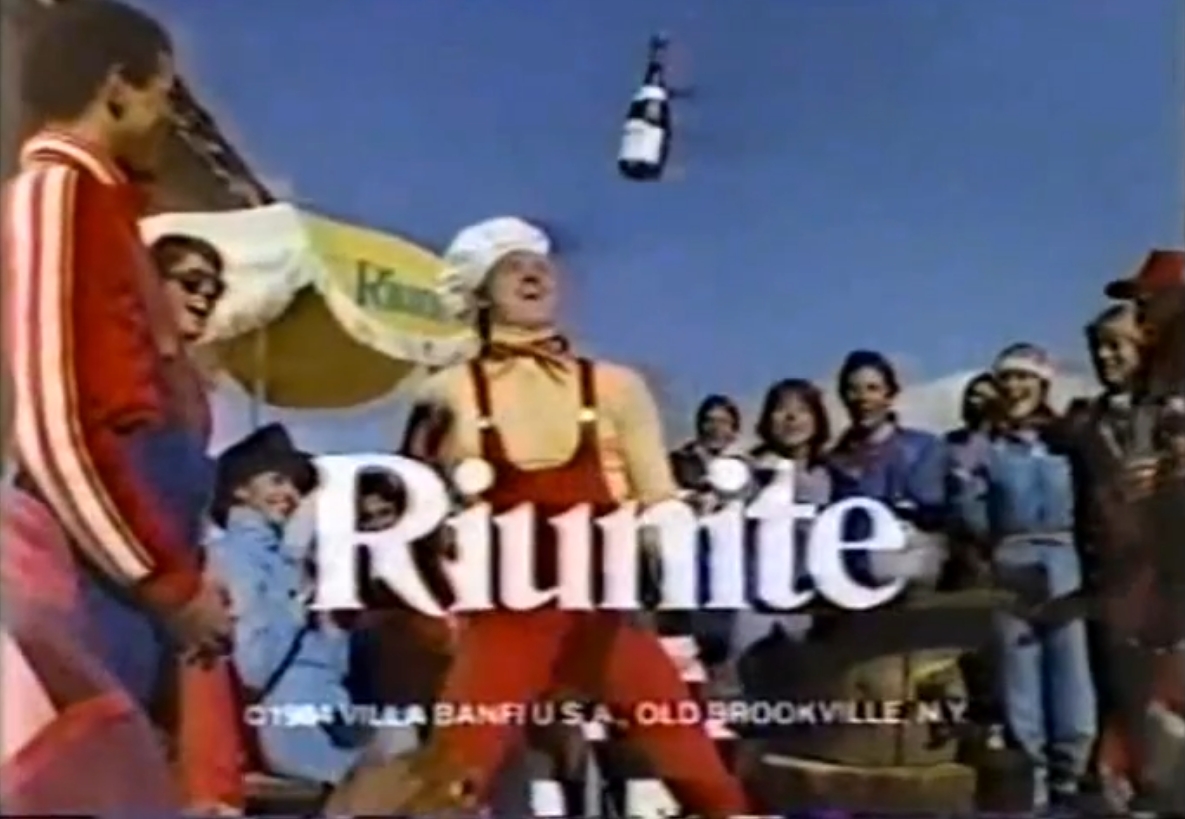
The joie-de-vivre-drenched folks in this 1984 television commercial embody the essence of conviviality. The advertisement encapsulates Riunite’s brand strategy: Wine was not presented as something to study. It was something to put on ice, pass among friends and enjoy right now. It is largely, although not completely, divorced from its roots in Italy’s Emilia-Romana region. This relationship mirrors so many Italian-American stories: A desire and drive to embrace American traditions and values often at the expense of cultural traditions.
The story began in Emilia-Romagna, not in an advertising agency. In 1950, nine cooperative wineries in the province of Reggio Emilia joined together to form Cantine Cooperative Riunite. The cooperative structure gave local growers the scale, purchasing power and marketing reach that individual farming families rarely possessed. Riunite remains cooperative in character. Today, it draws upon the work of approximately 1,450 winegrowing families. The bridge to America was built by the Mariani family; Italian-Americans with roots in Lombardy and strong ties to Milan.
John F. Mariani Sr. had founded the House of Banfi in New York City in 1919, initially importing Italian foods and medicinal bitters. He named the company for his aunt, Teodolinda Banfi, an influential figure in his childhood who later served in the household of Pope Pius XI. Banfi moved into wine following the repeal of Prohibition and eventually became one of America’s most important importers.
In 1967, John Mariani Jr. and his brother Harry traveled to Italy looking specifically for a wine that was low in alcohol, slightly sweet and capable of being served cold. In Emilia-Romagna they encountered the fruity, lightly sparkling Lambrusco produced by Cantine Riunite.
Banfi did more than purchase an existing wine and ship it to America. The brothers worked with the cooperative’s managers and enologists to adapt the blend for the American market. According to a history compiled from contemporary business reporting, they experimented with grape proportions, emphasized fruit and body, retained more sweetness and reduced the pressure of the wine’s natural effervescence. The latter adjustment also kept it beneath the threshold at which the United States taxed imported sparkling wine like Champagne. Fermentation was stopped early, leaving a wine with relatively low alcohol, remaining grape sugar and a gentle frizzante sparkle.
It was an authentic Emilian wine, but one consciously tuned to American tastes. Now that is a truly Italian-American story.
Banfi began testing Riunite in New York, Los Angeles, Chicago and Miami in 1968. The company sponsored consumer tastings and worked to persuade regional distributors to take a chance on an unfamiliar sparkling red wine. The acceleration was extraordinary. Riunite sold approximately 1.2 million cases in 1975, placing it second among imported wine brands. In 1976 (the same year of the Judgment of Paris), Banfi committed roughly $4 million to advertising and promotion. Sales reached approximately two million cases, and Riunite displaced Mateus as America’s leading imported wine.
A later Cornell University study concluded that Riunite’s success came from a nearly perfect combination of timing, consumer research, price, product adaptation and American distribution. By 1982, the brand represented approximately 27 percent of imported table wine and 7 percent of the entire American table-wine market. The Cornell case study is available here. (Note the amusing "Canine" typo in the title of the study. I believe they meant Cantine -- meaning, winery/cellar in Italian. Alas.)
Banfi’s ambition was not simply to defeat other wine brands. The company wanted Riunite to occupy the refrigerator alongside beer, juice and soft drinks. That positioning also reveals something about Italian-American cultural translation. Banfi was an Italian-American family business working with an Italian agricultural cooperative, but the advertisements seldom resembled the Italian-American family table. The old associations (basement barrels, Sunday dinner, immigrant neighborhoods and wine as a daily food) were replaced with a broadly American language of leisure. Italy remained present, but often as scenery: a gondola, or a romantic landscape or the vague promise of continental pleasure. Riunite was Italian enough to feel exciting, but familiar enough to require no explanation.
The success of Riunite transformed Banfi as well as American drinking habits. By 1983, the company was reportedly spending approximately $17 million on advertising, about 90 percent of it on television. Riunite sold more wine than the next several imported brands combined.
The profits and confidence generated by that success helped the Mariani family pursue a very different dream. Between 1978 and 1981, Banfi invested heavily in vineyards and winery properties in Italy, most notably in Montalcino. There it developed Castello Banfi into an ambitious producer of Brunello di Montalcino and other premium wines.
There is a marvelous paradox here. The sweet, inexpensive Lambrusco marketed as an alternative to soda helped build one of the most technologically advanced fine-wine estates in Tuscany. At the very moment the Judgment of Paris was rearranging the world’s hierarchy of prestigious wine, Riunite’s commercial success was helping an Italian-American importing family enter that hierarchy as producers.
Riunite eventually came to represent the entire Lambrusco category. And this remarkable visibility eventually created a problem. For many Americans, Riunite did not represent one particular expression of Lambrusco. It became Lambrusco. As American drinkers became more interested in Chardonnay, Cabernet Sauvignon and increasingly specific regions and varieties, Riunite came to symbolize a less sophisticated stage in their wine education. The great mistake is not that Riunite was somehow “false” Lambrusco. It was made in Emilia from Lambrusco grapes by an Emilian cooperative. Nor is sweetness inherently inauthentic. The official Lambrusco denominations permit wines ranging from dry and semidry to amabile and sweet. The distortion occurred when one commercially successful expression was allowed to stand for an entire family of wines.
Lambrusco is not one grape. It is a group of related varieties rooted principally in the provinces of Modena and Reggio Emilia. Lambrusco di Sorbara, for example, can produce pale, fragrant wines with soaring acidity and floral delicacy. Lambrusco Salamino generally gives deeper color, dark fruit and moderate structure. And Lambrusco Grasparossa can be darker, fuller and more tannic. Other varieties, including Maestri, Marani and Montericco, contribute still more variations. There are multiple protected denominations, among them Lambrusco di Sorbara, Lambrusco Salamino di Santa Croce, Lambrusco Grasparossa di Castelvetro, Reggiano and Modena. Wines may be red or rosato, gently frizzante or fully sparkling, and dry, off-dry or sweet. The Consorzio Tutela Lambrusco presents Lambrusco not as a single style but as a universe of grapes, territories and colors. Much of the wine is made through the Martinotti method, in which the secondary fermentation occurs in a pressurized tank. Other producers use traditional bottle fermentation or the ancestral method, sometimes leaving the wine un-disgorged.
Most importantly, like all wines, Lambrusco belongs to the table. Emilia’s bright, bubbling reds make sense beside the region’s rich cooking: mortadella, prosciutto, salami, Parmigiano-Reggiano, filled pastas, ragù and more. Acidity, bubbles and light tannin refresh the palate after fat, salt and cheese. Seen this way, the American picnic advertisements were not entirely foolish. Riunite understood the wine’s conviviality and adaptability. What the advertising omitted was its agricultural and regional specificity. But now, in 21st century Italian-America, we’re bringing that history back to the fore.