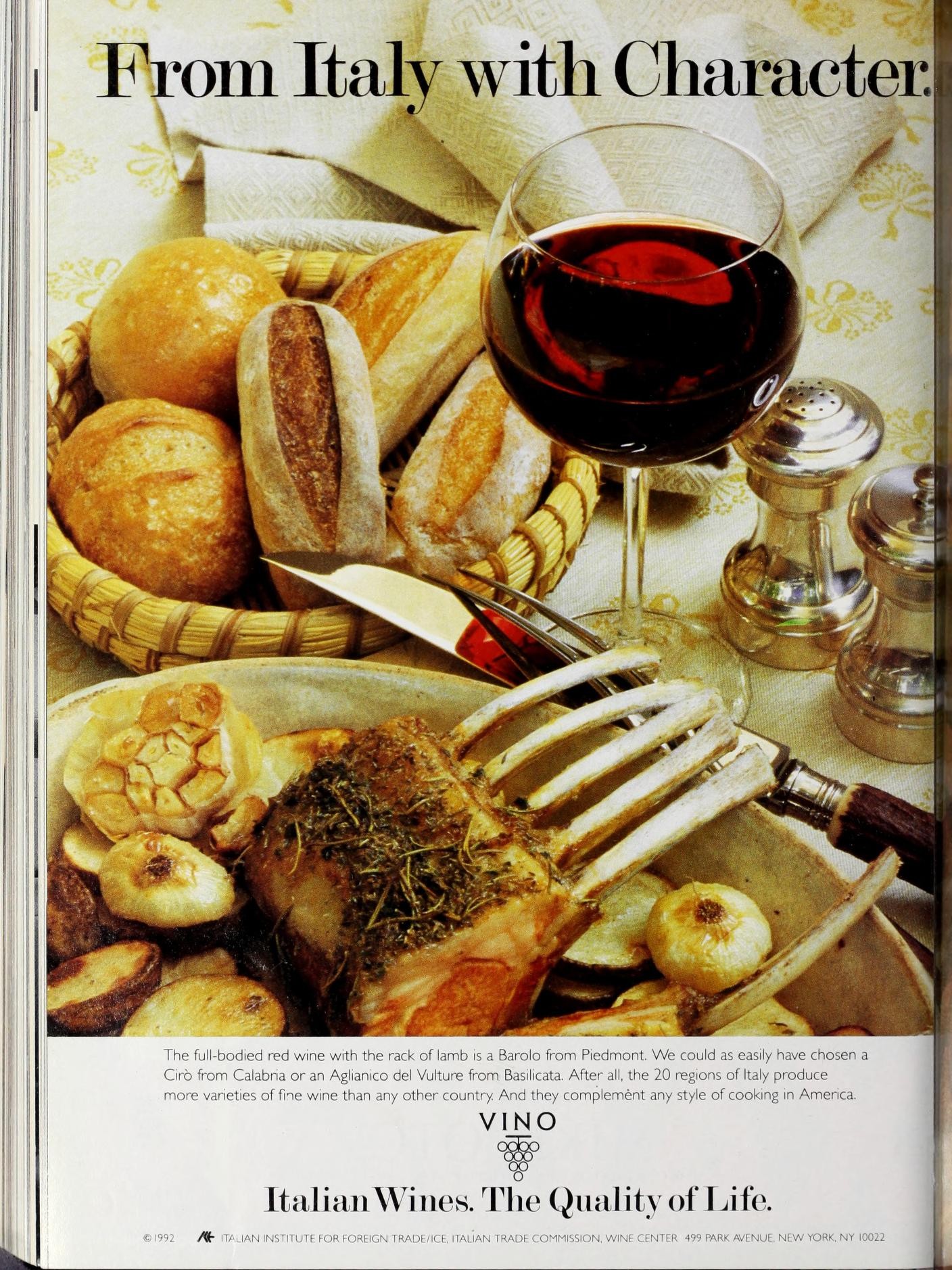
This full-page advertisement in a 1992 edition of Vanity Fair was placed by an Italian government agency charged with shaping American perceptions of Italian wine. Most notably, the ad calls attention to Italy’s twenty distinct regions, including the island regions of Sicily and Sardinia. Each developed under its own particular political, linguistic, culinary, and cultural influences over hundreds, if not thousands, of years. It was not until the unification of Italy in 1861 that these regions found themselves under the aegis of a single nation.
Despite unification, the regions have retained a fierce sense of individual identity. This is not difficult to understand: many are separated by mountain ranges and other difficult terrain that historically limited communication between neighboring communities. Some regions are inland, while others are coastal; some became industrial centers, while others continued to rely heavily upon agriculture. Geography allowed local dialects, cuisines, grape varieties, and winemaking traditions to remain remarkably distinct, even among neighbors.
But here, the Italian Trade Commission knits all twenty regions together under the banner of Italian wine. The advertisement acknowledges their differences while presenting their extraordinary diversity as a collective national strength. A Barolo from Piedmont accompanies the rack of lamb, but the copy reminds American readers that a Cirò from Calabria or an Aglianico del Vulture from Basilicata might just as easily have occupied the same place: in this glass, on this table.
Italy is not presented as the source of one definitive style of wine, but as a country containing a vast constellation of grapes, landscapes, climates, and culinary traditions. The unity being proposed is promotional rather than homogenizing: each region retains its identity while contributing to the larger idea of Italian wine.
The image reinforces this message. The Barolo sits beside a rack of lamb, roasted garlic, onions, potatoes, and a basket of bread. It is not isolated for formal contemplation or presented as a luxury object. It belongs to the meal. The wine is not an accessory to Italian life; it is part of its structure.
The campaign’s closing line, “Italian Wines. The Quality of Life,” distills the larger argument. Italian wine is being sold not simply as a beverage, but as an expression of a shared way of living across Italy. Each region may interpret that life differently, but they converge upon one essential principle: wine belongs at the table. We couldn’t agree more.