By the mid-1980s, wine had become firmly embedded in American dining culture. California had proven it could produce world-class wines, varietal labeling had become second nature, and domestic consumers increasingly understood the difference between Napa Cabernet, Sonoma Chardonnay, and Bordeaux. The debate was no longer whether Americans should drink wine. It was which wine, and what kind of experience that choice represented.
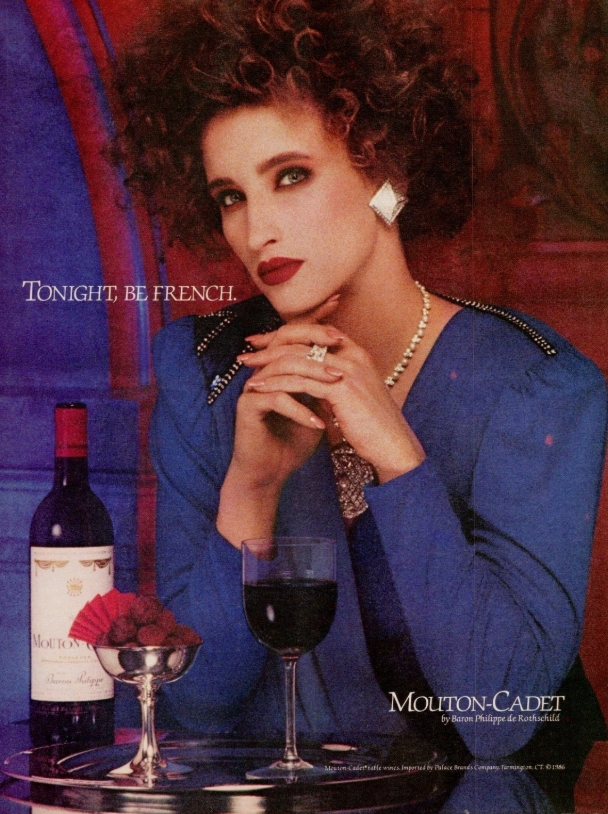
Unlike earlier French advertisements that emphasized centuries of tradition or appellations unfamiliar to American consumers, Mouton-Cadet makes a remarkably simple proposition in this ad: Tonight, Be French. Because last night, perhaps you weren’t…
The headline invites the reader to adopt an inherently ephemeral identity. France is presented not as a geography but as a mood; it promises elegance, romance, and sophistication. The featured image reinforces the message: The dramatic lighting, tailored blue dress, pearls, bold lipstick, and refined table setting evoke the visual language of luxury magazines rather than agricultural products. Wine is officially a cultural accessory.
This approach may have made little sense twenty years earlier. In the 1950s, many Americans were still learning to appreciate table wine. By 1986, however, wine drinkers were increasingly confident and adventurous. They understood that ordering a California Cabernet or a Bordeaux carried different cultural associations.
It took decades to arrive at this point. The Mouton-Cadet label itself was created in 1930 by Baron Philippe de Rothschild, owner of the legendary Château Mouton Rothschild. After several disappointing Bordeaux vintages, the Baron chose not to bottle those wines under his prestigious château label. Instead, he created an entirely new wine called Mouton-Cadet. The word cadet referred both to the younger wine and to Philippe himself, the youngest son of his family. What began as a practical solution soon became one of the most influential branding innovations in wine history. Rather than marketing a single château, Mouton-Cadet assembled wines from growers across Bordeaux to create a consistent, approachable expression of the region. It was one of the earliest truly international Bordeaux brands, offering consumers the prestige of Bordeaux without the price or complexity of classified growths. Over time, it became the best-selling branded Bordeaux wine in the world.
By 1986, American consumers had become sophisticated enough to choose not simply between red and white, or domestic and imported, but between different cultural experiences. California offered innovation, confidence, and the excitement of a rising wine nation; France offered heritage, refinement, and the romance of European dining. The choice was no longer about quality alone. It was about identity. And perhaps this is still true today: What we drink is who we are.