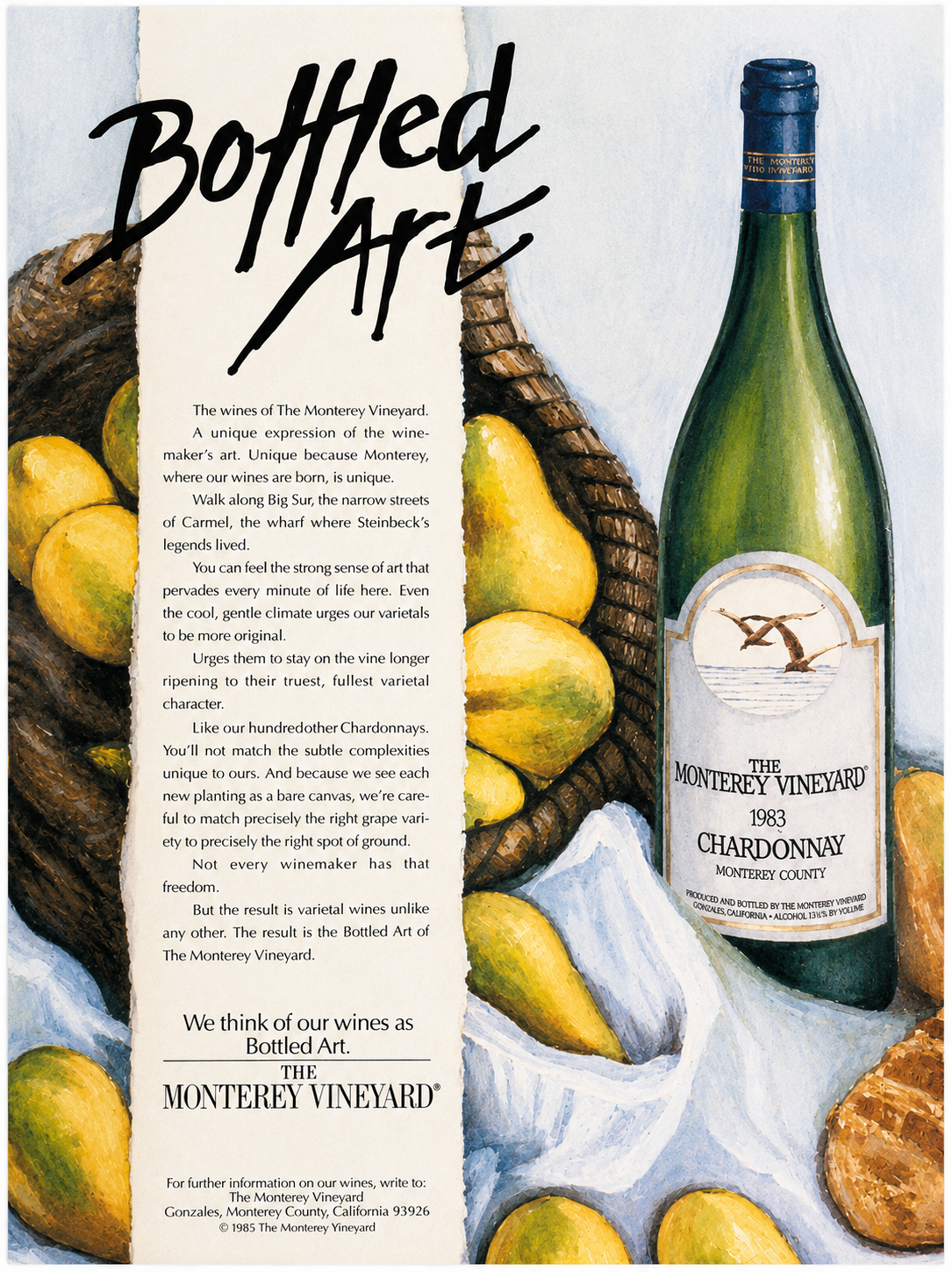
By 1985, California wine no longer needed to borrow from European identity. Less than a decade after the Judgment of Paris stunned the wine world, California's finest producers were speaking with a new voice rooted not in imitation, but in place. Rather than emphasizing European tradition, California wineries increasingly celebrated their home turf. This particular vintage advertisement thus captures a precise moment in the history of wine in America. For much of the twentieth century, California's premium wine narrative centered on Napa and Sonoma. With these areas firmly established for their quality, attention expanded toward neighboring areas like Monterey. Here, cool Pacific breezes, morning fog, and an unusually long growing season proved ideal for Chardonnay and Pinot Noir.
The advertisement contains no list of awards. No comparisons to France. No promises of prestige through borrowed European names. Instead, it likens the work of the winemaker to that of an artist. Each vineyard planting becomes "a bare canvas." And selecting the proper grape for the proper site becomes an act of creative judgment rather than simple agriculture. Even the illustration reinforces the message: Instead of a conventional product photograph, the bottle appears within a painterly still life of fruit, bread, woven baskets, and flowing fabric. The composition recalls the tradition of late nineteenth- and early twentieth-century still-life painting, where ordinary objects became subjects worthy of careful contemplation. Whether consciously inspired by artists such as Paul Cézanne or simply borrowing from that visual vocabulary, the advertisement communicates refinement rather than commerce. This bottle of wine is not merely on offer; it is a curated selection worthy of investment. Indeed, by 1985, wine had become part of a broader cultural conversation. It was increasingly associated with travel, regional identity, literature, food, and the arts. The copy invites readers to stroll through Carmel, visit Big Sur, and remember John Steinbeck before discussing the wine itself. Place comes before product. The intended consumer was no longer simply purchasing a bottle for dinner. They were buying into ideas. By 1985, wine had become a subject of learning and conversation as much as one of consumption.
Although The Monterey Vineyard eventually disappeared as an independent brand, the ideas it championed endured. Monterey County is now recognized as one of California's great cool-climate wine regions, celebrated for Chardonnay and Pinot Noir that express a distinctly maritime character. In many respects, the advertisement anticipated that future, presenting Monterey not as an emerging region but as one already worthy of admiration.