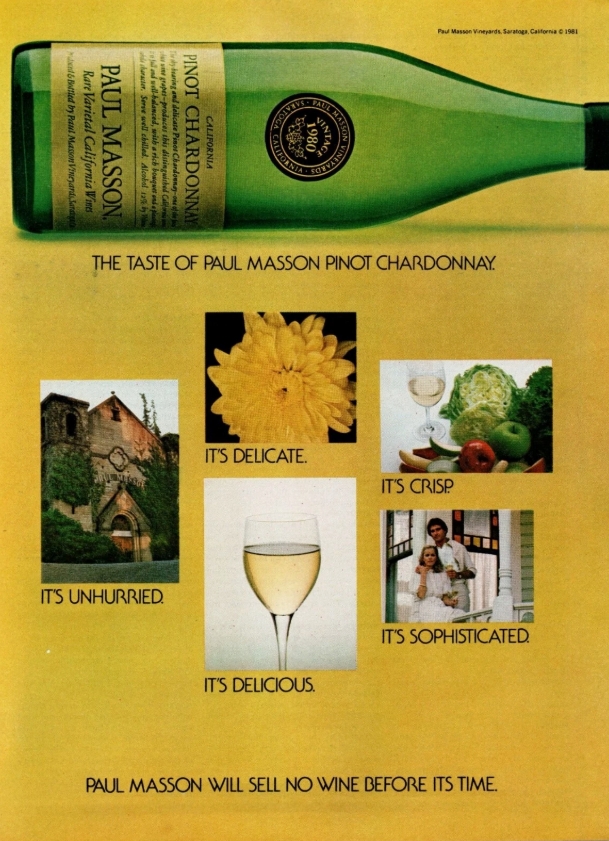
At first glance, this 1981 Paul Masson advertisement appears to celebrate one of California's favorite white wines. But look closely at the label and you'll notice something that would puzzle many modern wine drinkers.
The bottle doesn't say Chardonnay.
It says Pinot Chardonnay.
Today, the phrase has all but disappeared from the wine world. Yet for much of the twentieth century, Pinot Chardonnay was a perfectly acceptable name for the grape we now simply call Chardonnay. This small linguistic relic opens a fascinating window into the history of grape identification, and into the moment when California wine was beginning to speak with surety.
Long before DNA testing, grape varieties were identified through ampelography. This is a centuries-old science used to describe vines by their leaves, shoots, clusters, berries, and growth habits. Without genetic analysis, growers relied on careful observation. Grapes that looked alike were often assumed to be closely related, while the same variety might acquire different names as it spread across Europe. Chardonnay was one such grape.
For generations, many viticulturists regarded it as part of the broad Pinot family because of its striking similarities in leaf shape, cluster morphology, and vine characteristics. As a result, the name Pinot Chardonnay became widely accepted in California and elsewhere, particularly during the mid-twentieth century. Here, Paul Masson wasn't suggesting a blend of Pinot Noir and Chardonnay. It was simply using an older synonym for Chardonnay itself.
But in the 1990s, advances in DNA fingerprinting transformed ampelography from a science based largely on observation into one grounded in genetics. Researchers confirmed that Chardonnay is indeed closely related to Pinot, but not because it is a "type" of Pinot. Instead, Chardonnay is the natural offspring of Pinot and Gouais Blanc, an ancient white grape once widely planted throughout medieval Europe. That discovery explained why early ampelographers had sensed a relationship while also justifying the modern decision to treat Chardonnay as its own distinct variety. So by the end of the twentieth century, the modifier "Pinot" had quietly disappeared from premium wine labels.
Writ-large, by 1981, California wineries had largely abandoned European-style place names such as Chablis and Burgundy for their premium wines. Consumers were becoming comfortable ordering Cabernet Sauvignon, Merlot, Sauvignon Blanc, and Chardonnay by grape variety rather than by borrowed geography. Yet Paul Masson's label reminds us that the vocabulary of wine was still evolving. Indeed, while the industry had standardized what Americans were drinking, it was still refining what to call it.