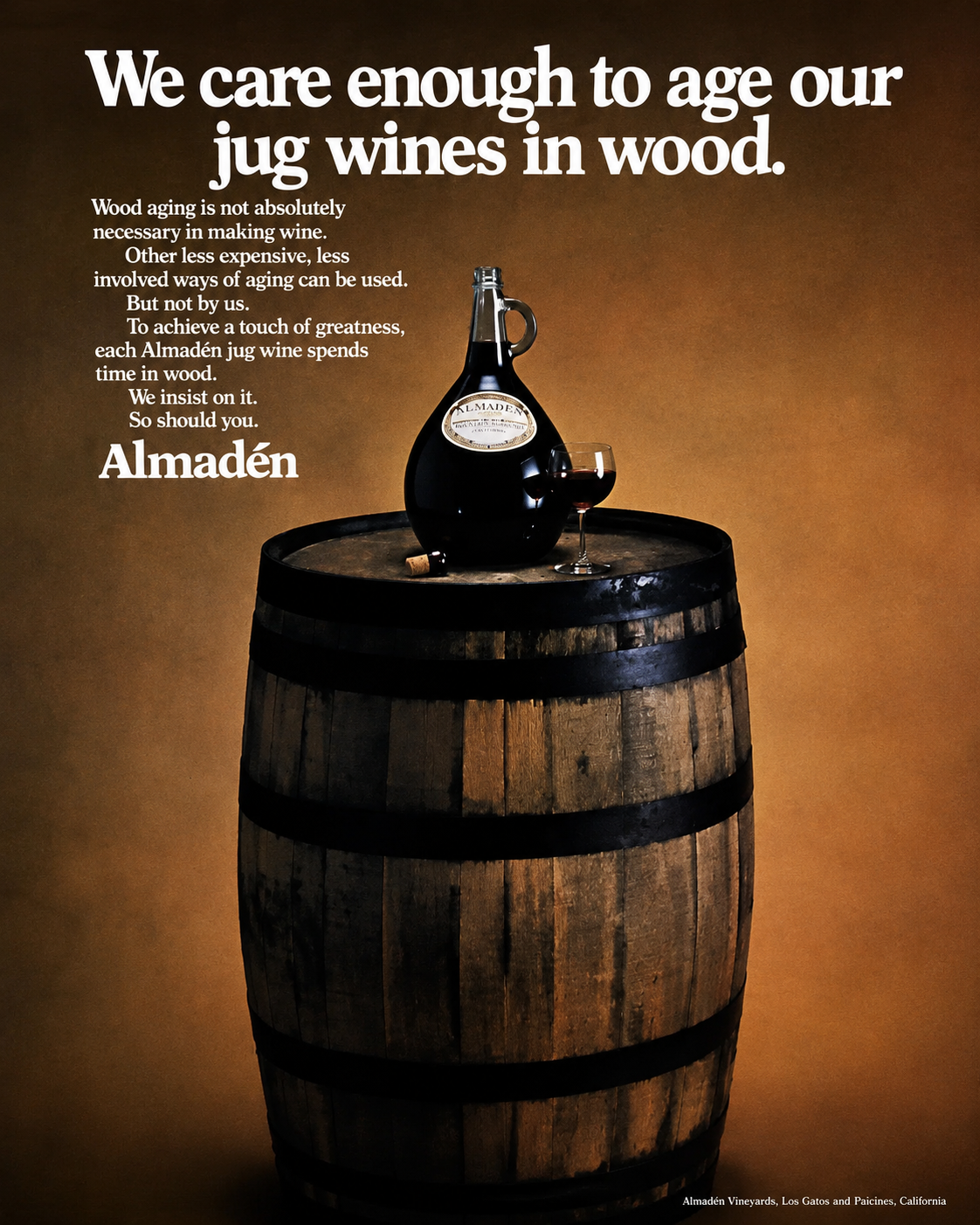
In 1975, just one year before California wines shocked the world at the Judgment of Paris, Almadén Vineyards published an advertisement with this headline:
"We care enough to age our jug wines in wood."
At first glance, the claim almost sounds contradictory. Jug wine? Wood aging? Today we associate oak barrels with premium Cabernet Sauvignon, Pinot Noir, and Chardonnay. But in 1975, Almadén was making a very different argument. The company wanted consumers to understand that inexpensive wine didn't have to be carelessly made. Sometimes, good wine was simply packaged differently. After all., aging wine in oak isn't free. Every month a wine rests in barrel ties up capital. The winery must purchase barrels, store the wine, and wait months (or even years) before selling a single bottle. Those carrying costs inevitably become part of the wine's price. Almadén wasn't claiming its jug wines spent years in expensive French oak like a classified-growth Bordeaux. Rather, it was emphasizing that even an everyday table wine deserved at least some thoughtful aging before it reached the dinner table
Almadén's story begins long before Napa Valley became America's most famous wine region. In 1852, French immigrant Étienne Théé established a winery in the Santa Clara Valley near present-day Los Gatos. He named it after the nearby New Almaden Mercury Mine, itself named for the famous mercury mines of Almadén, Spain. Today, this area is known around the world as Silicon Valley. Now the area is dominated by Apple, Google, and NVIDIA. But in the nineteenth century, Santa Clara Valley looked completely different. It was a landscape of vineyards, orchards, and wineries. Almadén was one of the pioneers that helped establish California's wine industry decades before technology transformed the region. This advertisement appeared in 1975, just one year before the 1976 Judgment of Paris – the event forever changed international perceptions of American wine. Seen through that lens, this advertisement becomes almost prophetic. California producers were already insisting that craftsmanship mattered. The world simply hadn't caught up yet.
Of course, as consumer preferences shifted toward premium varietal wines and smaller bottles, the classic gallon jug slowly disappeared from American tables. The brand passed through several corporate owners over the decades and eventually the name was lost to time. Yet Almadén's place in American wine history remains secure. Long before California earned international acclaim, it helped introduce millions of Americans to wine and laid the groundwork for the revolution that was just around the corner.