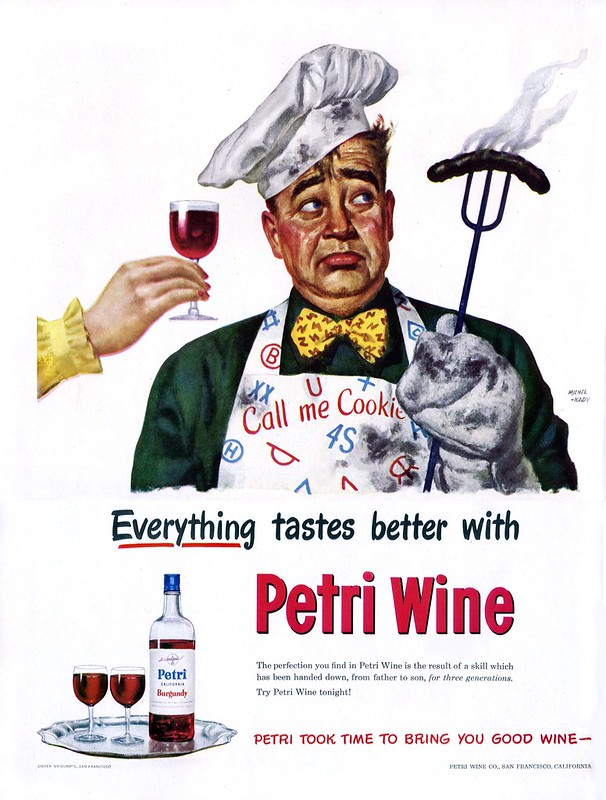
Originally published in the May 16, 1949 issue of Life magazine
On Monday, May 16, 1949, America stood on the threshold of a new era: The Second World War was over, the economy was booming, and millions of returning veterans were buying homes, starting families, and settling into a new kind of American life. President Harry Truman was in the White House; overseas, Europe was rebuilding while Cold War tensions continued to mount. The number one song in the country was Doris Day's Again, and television was still a novelty at this time.
And thus, the pages of Life magazine were a potent source of information for American families, offering a weekly window into a rapidly changing nation. Buried among stories of sports, Hollywood, and post-war prosperity appeared a full-page advertisement for Petri Wine.
At first glance, it's simply a clever advertisement: A bow tie-sporting chef in a charcoal-dusted apron surveys his culinary mishap while an unseen woman (presumably) (represented only by a hand emerging from a ruffled yellow sleeve) offers him a glass of red wine as a consolation prize. The message is unmistakable: even a kitchen disaster is easier to swallow with a good bottle of wine. Yet, seventy-five years later, the advertisement tells a much larger story: It captures the moment when wine was transforming from an occasional luxury into an everyday pleasure, finding its place on American dinner tables alongside family meals, conversation, and the nation's favorite radio programs.
Before Napa Valley became synonymous with world-class Cabernet Sauvignon and decades before wine scores and celebrity winemakers dominated headlines, companies like Petri introduced millions of Americans to wine in the simplest possible way: make it affordable, approachable, and something to enjoy with dinner.
The advertisement doesn't mention terroir, vineyard elevation, barrel regimens, or collectible vintages. Instead, it promises something far more relatable: wine can simply make a meal better.
The Italian Immigrant Family Behind the Label
Like so many great American stories, Petri Wine began with Italian immigrants.
The Petri family arrived from Tuscany during the great wave of Italian immigration in the late nineteenth century. Family patriarch Raffaello Petri first operated a boarding house in San Francisco's North Beach neighborhood, serving meals and wine to fellow immigrants. According to company history, he soon realized that selling wine was a more promising business than renting rooms. What began with wine served in the basement of a boarding house evolved into one of California's largest wineries.
California's Mediterranean climate reminded many Italian immigrants like Raffaello Petri of home. Vineyards flourished, and immigrant families brought generations of winemaking knowledge with them. What had been everyday table wine in Italy slowly became everyday table wine in America. And by the early twentieth century, Petri had become one of California's leading wine producers.
Surviving Prohibition
Like every American winery, Petri faced its greatest challenge during Prohibition. Many wineries disappeared forever between 1920 and 1933. Others survived by producing sacramental wine, grape juice, or selling grapes for home winemaking, which remained legal under certain circumstances. But when Prohibition ended, Petri was ready.
The company expanded rapidly during the 1930s and 1940s, capitalizing on growing demand from a new generation of consumers who viewed wine not as an elite European indulgence but as part of everyday American life.
By the early 1950s, Petri had become the largest domestic wine producer in the United States.
What Became of Petri Wine?
Like many pioneering American wine brands, Petri eventually became part of a rapidly consolidating industry.
The company survived Prohibition and acquired many other well-known California wineries, including Italian Swiss Colony. Later, it became part of United Vintners. Through a series of mergers and acquisitions, the Petri name gradually disappeared from store shelves as ownership changed hands.
While the brand itself is gone, its influence remains.
Petri helped establish California wine as an everyday American product rather than a luxury reserved for special occasions. In many ways, the success enjoyed today by California wineries owes something to companies like Petri that spent decades introducing American families to the pleasures of sharing a bottle with dinner.
Our Modern Pour
While Petri no longer exists as a wine label, its philosophy lives on in producers committed to crafting honest, food-friendly wines. For our modern pour, we return to the Petri family's homeland of Tuscany with Fattoria Piazzano Chianti DOCG, a family-owned estate that bottles its wine in one of Italy's most enduring symbols: the fiasco.
The straw-wrapped fiasco (Italian for "flask" or "bottle") has been synonymous with Chianti for centuries. Renaissance artisans wrapped delicate glass bottles in woven straw to protect them during transport and to help them stand upright on uneven surfaces. Over time, the distinctive bottle became an international symbol of Tuscan hospitality, appearing in trattorias, family kitchens, and Italian restaurants around the world.
Had Raffaello Petri walked the hills surrounding Florence or Siena before leaving for California, bottles like these would have been a familiar sight. The iconic fiasco represents more than packaging. It evokes a way of life in which wine was meant to accompany conversation, food, and family.
Today, Fattoria Piazzano proudly continues that tradition. Produced from 85% Sangiovese, with Malvasia Nera and Canaiolo completing the blend, the wine is fermented with native yeasts and undergoes malolactic fermentation in traditional glass-lined cement tanks. Sustainably farmed and awarded 91 points by James Suckling, it reflects the same philosophy that made Petri a household name generations ago: honest wine, thoughtfully crafted, and made to be shared.