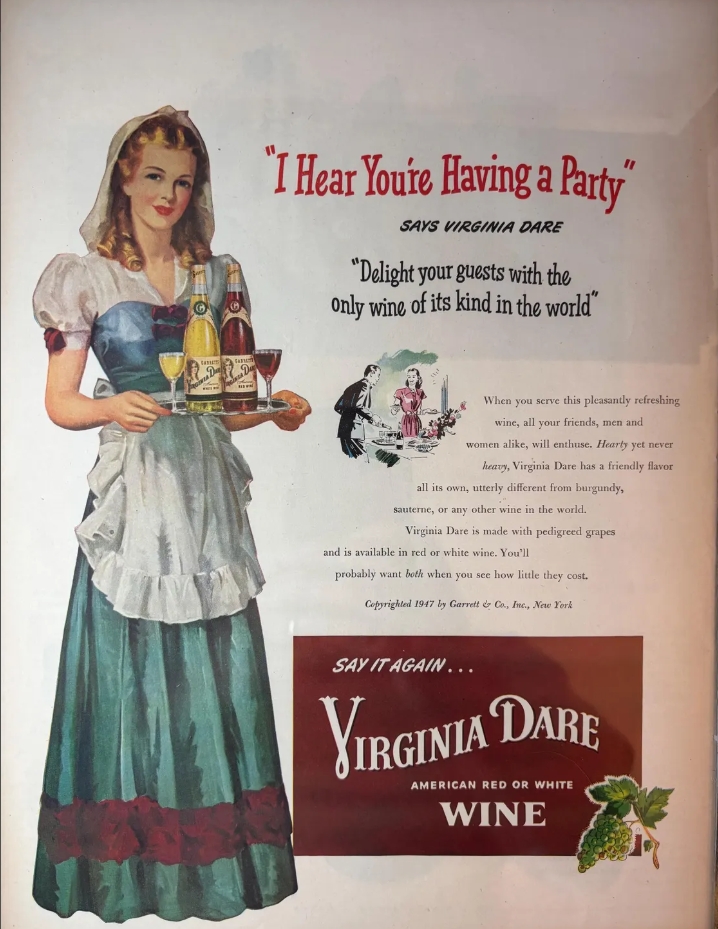
Long before Virginia Dare became a wine label, she was a symbol of America's earliest colonial history. Born on August 18, 1587, on Roanoke Island in present-day North Carolina, Virginia Dare was the first English child born in the Americas. Her grandfather, John White, served as governor of the struggling Roanoke Colony. Only weeks after her birth, White sailed back to England for supplies. Delayed by war with Spain, he did not return for three years. When he finally reached Roanoke in 1590, the colony, and little Virginia Dare, had vanished. By the late nineteenth century, Virginia Dare had become a national folk heroine. And later, in the mid-twentieth century, a symbol of American wine.
Virginia Dare was introduced by Garrett & Company, one of the giants of the early American wine industry. Founded in 1835 in New York City, Garrett began as an importer and wine merchant before evolving into one of America's first truly national wine companies.
Rather than relying on a single vineyard or winery, Garrett assembled an impressive network spanning several wine regions. Its operations included North Carolina, (growing and vinifying the now nearly extinct Scuppernong grape), the Finger Lakes, Southern California, and finally, Brooklyn. The New York City facility received shipments of vinified wine from all over the country for blending, bottling, and finally, distribution. This nationwide footprint was remarkable for its era. Long before modern wine conglomerates became commonplace, Garrett was sourcing grapes from multiple American regions, blending wines, bottling them in Brooklyn, and shipping them across the country.
By the late twentieth century, Virginia Dare had largely disappeared from store shelves. Although the brand had once been among America's best known wines, changing consumer tastes and industry consolidation pushed it into obscurity. In 2013, Francis Ford Coppola decided to bring it back. Having already devoted decades to restoring Napa Valley's historic Inglenook estate, Coppola turned his attention to another chapter of American wine history. At a historic winery in Geyserville, Sonoma County, he launched Virginia Dare Winery, reviving one of the country's oldest wine names. The goal wasn't to recreate the inexpensive table wines of the 1940s. Instead, Coppola sought to honor Virginia Dare's legacy while producing premium California wines that celebrated America's winemaking heritage. Unfortunately, the revival proved brief. In 2021, Coppola sold his Sonoma wine business to Delicato Family Wines, while retaining ownership of Inglenook, the historic Napa estate he had painstakingly restored over several decades. By 2025, winemaking at the Virginia Dare property had ceased, with production consolidated elsewhere within Delicato's operations.
Today, Virginia Dare remains less a commercial success than a remarkable story spanning nearly two centuries: from the mystery of the Lost Colony to Brooklyn bottling lines, California vineyards, and an Italian-American filmmaker's determination to preserve a piece of American history.