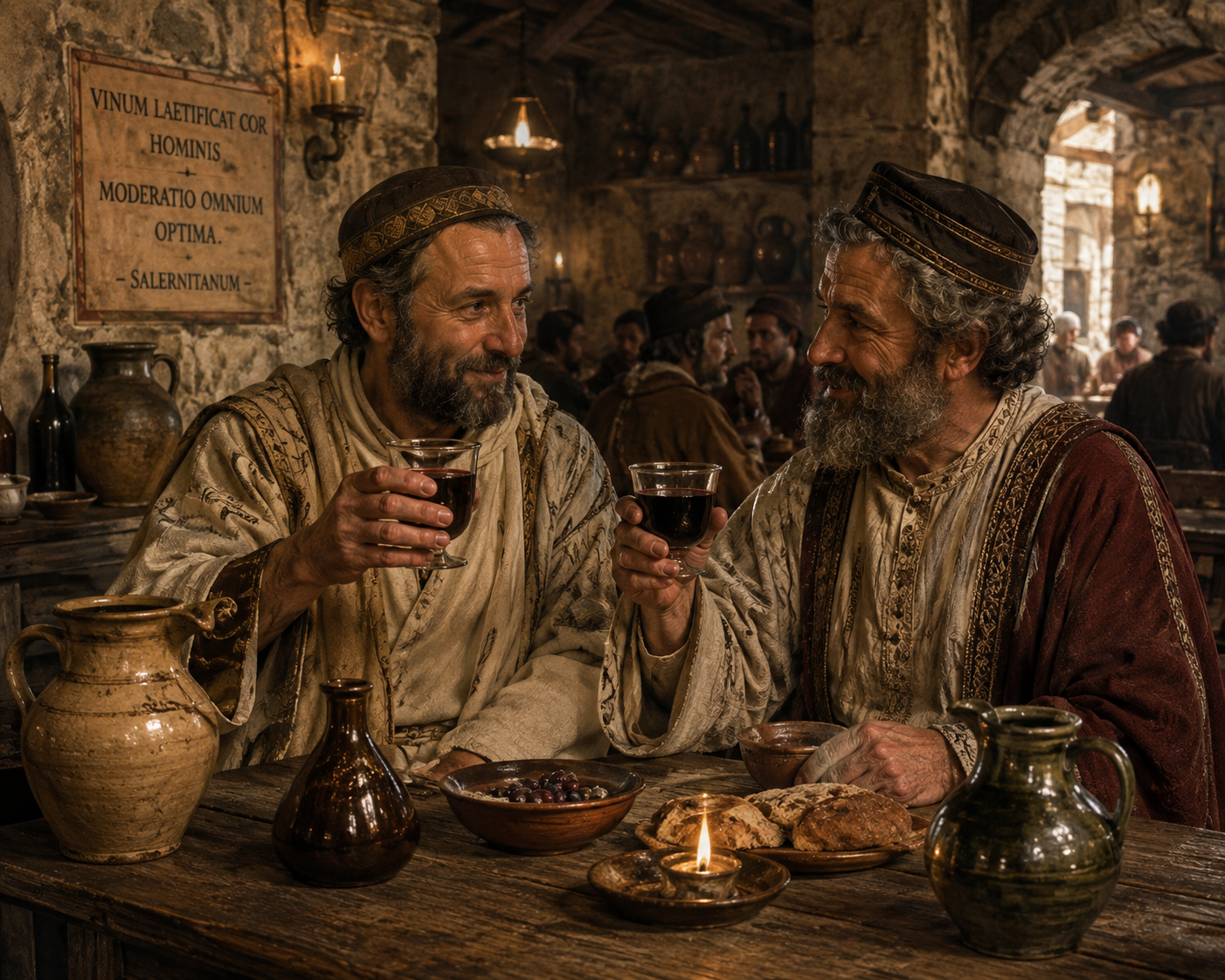
Long before cardiologists debated the Mediterranean diet or researchers investigated the relationship between moderate wine consumption and cardiovascular health, physicians at Europe's first great medical school had already reached a remarkably familiar conclusion.
Wine belongs at the table as part of a balanced way of living!
Europe's first medical school evaluated wine the way modern physicians evaluate diet: according to its characteristics, the individual consuming it, and the broader context of health. The Schola Medica Salernitana, or Medical School of Salerno, flourished in southern Italy during the Middle Ages and is widely regarded as Europe's first medical school. Around the twelfth century, its physicians compiled one of history's most influential health manuals: the Regimen Sanitatis Salernitanum (The Salernitan Rule of Health). Written in poetic Latin verse, the work offered practical advice on diet, exercise, sleep, emotional well-being, and daily habits. For centuries, it served as Europe's most widely read guide to healthy living. Wine prominently appears throughout the Regimen as just one component of a thoughtful, balanced, well-lived life.
Perhaps the most enduring lesson from the Salernitan physicians is one that modern medicine continues to emphasize: Moderation matters. Thoughtful, metered wine (and presumably spirits) consumption is associated with a healthy existence. Wine is portrayed not as something to be avoided, but as something to be respected. The Salernitan doctors also understood that not all wines were suited to all people. The ideal wine depended upon the individual: Age, constitution, season, and health should be considered. Rather than recommending one universally "healthy" wine, they personalized recommendations based on the individual. (Much like we do today in small, local wine and spirits shops.)
One of benefits of wine cited throughout the Regimen is its ability to promote digestion. Consumed appropriately, wine was believed to comfort the stomach and assist the body's ability to wring nutrition from the foods we consume. Now whether or not every medieval theory withstands modern scientific scrutiny, the broader philosophy remains noteworthy: wine was evaluated according to how it fit within the rhythms of daily life rather than as an isolated substance.
Nearly nine hundred years later, the discussion about wine consumption and lifestyle continues. Modern research has become far more sophisticated, employing randomized trials, epidemiology, and molecular biology rather than humoral theory. Yet many contemporary discussions surrounding wine echo themes that would have sounded familiar in medieval Salerno: viewing wine within the broader context of a healthy dietary pattern rather than as a medicine in itself. While the science has changed, our questions about wine and health have not.