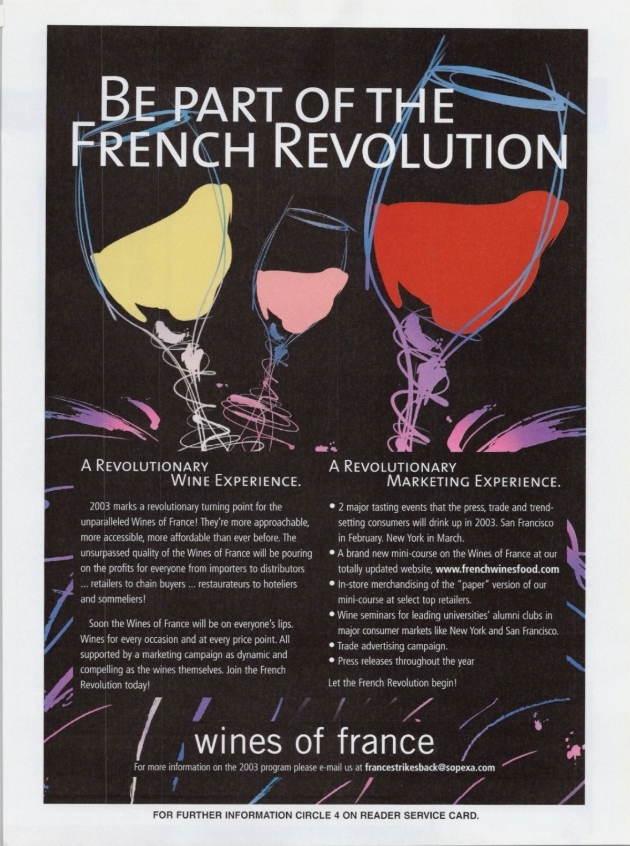
This 2003 trade advertisement, published under aegis of Wines of France (a promotional collective), reveals the country’s determination to court a broader and more casual market. Although the ad directly addresses members of the trade (e.g. retailers, restaurateurs, hoteliers and sommeliers), its ultimate target was the everyday consumer. That is, the person seeking a bottle after work rather than a trophy for their cellar. The campaign attempted to dismantle the perception that French wines were intimidating, exclusive and prohibitively expensive. Instead, it presented them as “more approachable, more accessible” and “more affordable than ever before.”
The advertisement playfully borrows the language of the French Revolution. Between 1789 and 1799, France overthrew its monarchy, dismantled much of its feudal order and advanced the radical proposition that society should not remain organized around inherited privilege. Here, the metaphor is playful but strategically chosen: French wine was attempting to loosen its own aristocratic image.
By the early 2000s, the democratization of wine was already well underway, aided in part by New World producers offering recognizable grape varieties, straightforward labels and accessible prices. France was not so much leading this revolution as responding decisively to it. The advertisement promised wines “for every occasion and at every price point,” supported by tastings, educational programs, retail merchandising and a national advertising campaign. It was a coordinated effort to reconnect French wine with consumers who might previously have found it confusing or unapproachable.
The bistro tables had in fact turned. Wine no longer needed to function as a status symbol or marker of privilege. It could be an everyday pleasure: a multifaceted beverage carrying the character and energy of its place and people. The revolution promoted here was not an overthrow of French winemaking tradition, but a change in how that tradition was presented. French wine belonged not only in private cellars and white-tablecloth dining rooms, the advertisement suggested but also paired with a burger and fries on a Tuesday night.