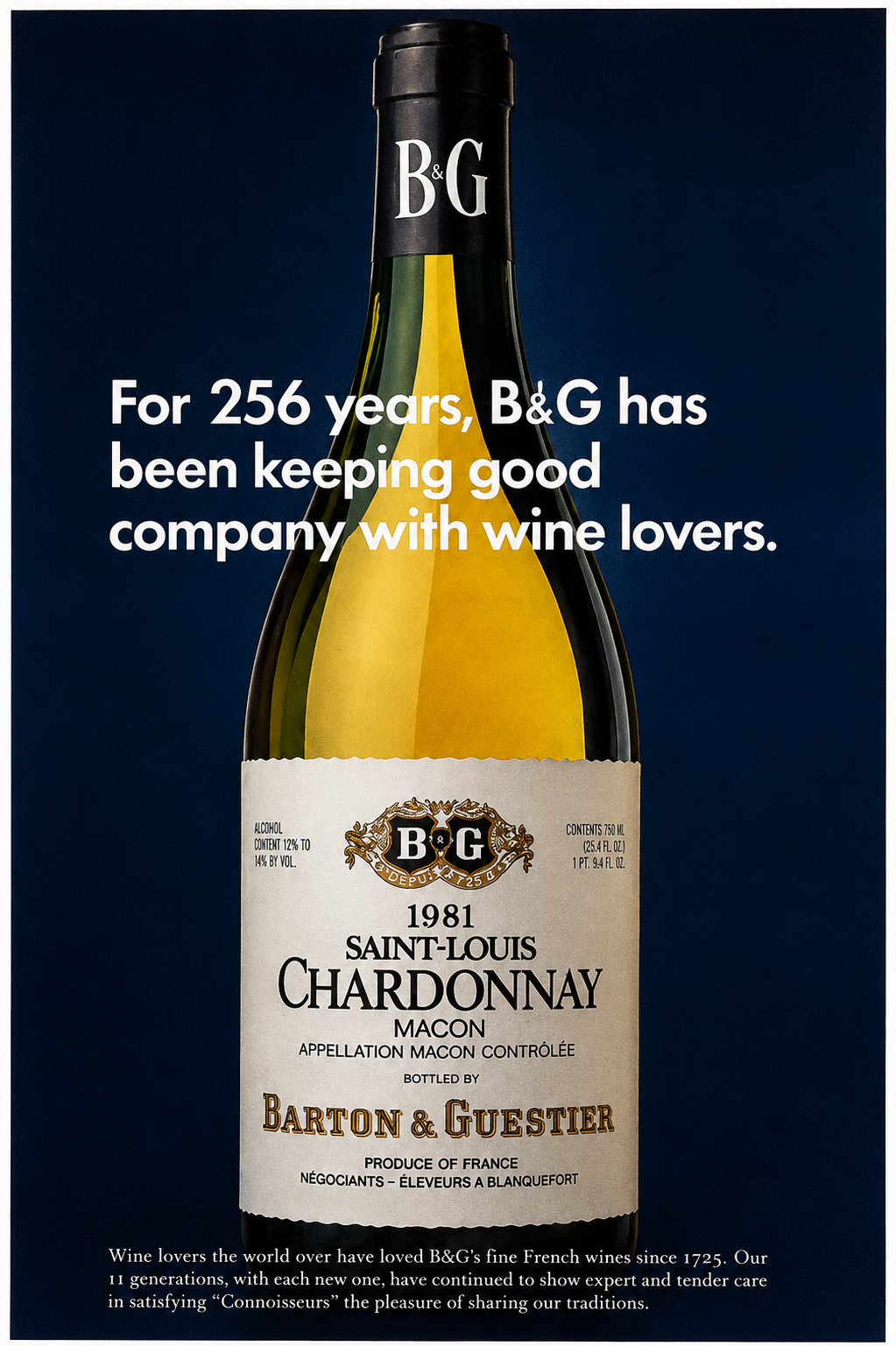
In this 1982 advertisement, Barton & Guestier did not assume that an American wine drinker would be persuaded by geography alone. Instead, the bottle presented one familiar word in bold, prominent type: Chardonnay.
That distinction renders this advertisement an intriguing record of French wine marketing in the years after the 1976 Judgment of Paris. By the early 1980s, French producers were no longer addressing an American market in which France’s superiority could simply be taken for granted. California had become a serious competitor, and American consumers were increasingly accustomed to shopping for wine by grape variety (e.g. Chardonnay, Cabernet Sauvignon and Pinot Noir) rather than beginning with an unfamiliar European place-name (e.g. Burgundy, The Rhine). The advertisement also proudly asserts that B&G had been making wine for 256 years. Indeed, at a time when California wine represented discovery and new innovation, Barton & Guestier represented tried-and-true experience. This brand could not be accused of an anxious, hollow pursuit of wine industry trends. Rather, B&G had been introducing wine to international consumers for more than two and a half centuries. The company’s history even includes correspondence with Thomas Jefferson, who identified Barton among his preferred wine suppliers and was known to request Barton & Guestier wines for personal consumption.
Barton & Guestier, to this date, describes itself as the oldest wine house operating in Bordeaux. It was founded in 1725 by Thomas Barton. Irish by birth, Barton settled in Bordeaux and established a wine-trading business. His grandson, Hugh Barton, grew the business in partnership with French sea captain and merchant Daniel Guestier. Beginning in 1802, the brand was re-named Barton & Guestier.
It may be said that the United States represented both opportunity and danger for B&G in 1982: Americans were becoming more interested in wine, sure -- but French bottles had to compete with a rapidly developing California industry that understood American retail language, American advertising, and American cultural expectations.
Finally, the advertisement also hints at the next stage in the American wine consumer’s education: Once shoppers learned to recognize Chardonnay by name, they could begin to distinguish between expressions of the same grape grown in different places. A California Chardonnay and a Chardonnay from Mâcon might share a varietal identity yet offer very different experiences in the glass. Climate, soils, vineyard conditions, native microbial communities, and winemaking choices all shape how a grape expresses itself. By leading with “Chardonnay” while still identifying the wine as Mâcon, this ad invited Americans to move beyond simply asking, “What grape is this?” and toward the deeper question: “What does this grape taste like when it comes from here?”