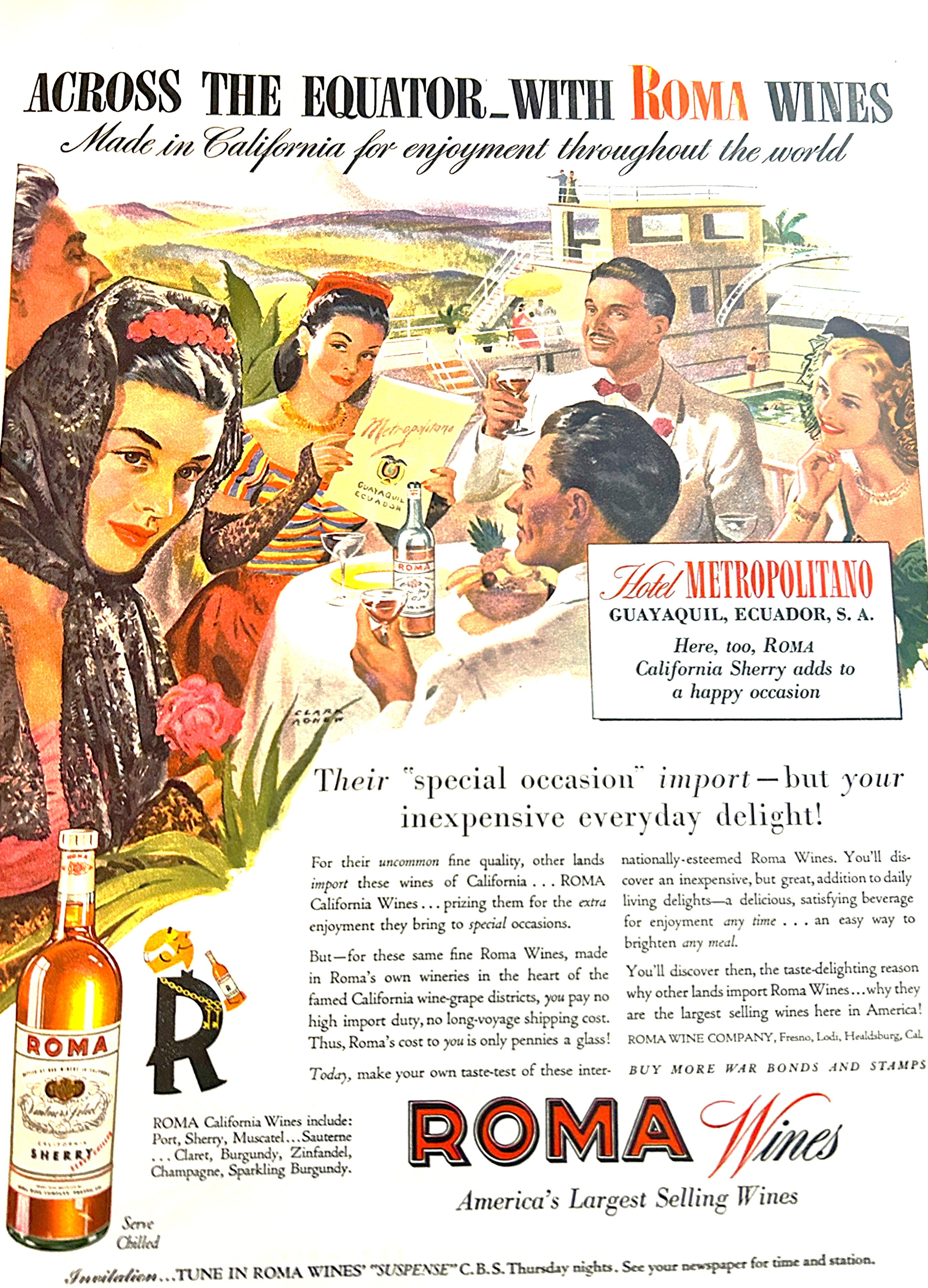
Most people assume California wine only became globally respected in the late twentieth century. This advertisement reveals a far more nuanced story: California wineries were already cultivating an international identity decades earlier, even if the wines themselves hadn't yet achieved world-wide acclaim.
This ad for Roma wines helped to create and reinforce a belief that California wine belongs on a world stage.
The ad also evidences cross-channel marketing promotions still prevalent today: As indicated at the bottom of this ad, Roma Wines was the title sponsor of a beloved radio drama called Suspense on CBS. Roma became the program's sponsor on December 2, 1943, remaining with the show until November 20, 1947. During those four years, announcers opened and closed each episode with Roma commercials, making the winery's name inseparable from the program for millions of listeners.
Today, wineries sponsor social media posts, podcasts, and trade/consumer tastings. But in the 1940s, the biggest wineries sponsored prime-time network entertainment. That says a lot about Roma's size, ambition, and place in American culture at the time.
The Story Behind Roma Wines
Roma Wine Company traces its roots to Lelio Tralli, an Italian immigrant from the Emilia-Romagna region who founded the company in 1910. Like many successful California vintners of the era, Tralli recognized that California's warm climate and fertile valleys could produce abundant, affordable wines for a rapidly growing American market.
The company established wineries in Fresno, Lodi, and Healdsburg, sourcing grapes from some of California's most productive vineyard regions. Fresno supplied generous crops from the San Joaquin Valley, Lodi became known for dependable old-vine Zinfandel and other Mediterranean varieties, while Sonoma County's Healdsburg facilities connected the brand with California's premium North Coast vineyards.
Following the repeal of Prohibition in 1933, Roma expanded at a remarkable pace. Rather than concentrating solely on fine wines, the company embraced a philosophy that wine belonged on the everyday American table. By the 1940s, Roma offered an enormous portfolio. And advertisements such as this one reflected Roma's extraordinary success. The company proudly deemed itself "America's Largest Selling Wines," a claim supported by its national distribution and aggressive advertising campaigns.
Like many of California's mass-market wine giants, however, Roma's fortunes changed as American tastes evolved. Beginning in the 1960s and accelerating after the 1976 Judgment of Paris, consumers increasingly sought varietal wines and smaller premium producers rather than the generic "Burgundy," "Claret," and "Sauterne" bottlings that had once dominated store shelves. Ownership changed hands several times, production gradually diminished, and the Roma label eventually disappeared from the marketplace, surviving today primarily through vintage advertisements that capture an important chapter in California wine history.
Our Modern Pour: Tenuta Pederzana Margherita Lambrusco dell'Emilia Semisecco
Lelio Tralli left Emilia-Romagna to build one of America's best-known wine companies, but his story began among the vineyards of northern Italy. To honor Roma's founder, we raise a glass of Tenuta Pederzana Margherita Lambrusco dell'Emilia Semisecco. Crafted from the historic Grasparossa di Castelvetro grape, this authentic Lambrusco reflects the region's centuries-old winemaking traditions. Long before sweet commercial bottlings shaped Americans' perception of Lambrusco, the wine was celebrated in Emilia-Romagna as a lively, food-friendly companion to the local table. Here's to Lelio Tralli, and to the Italian roots that helped shape California wine.